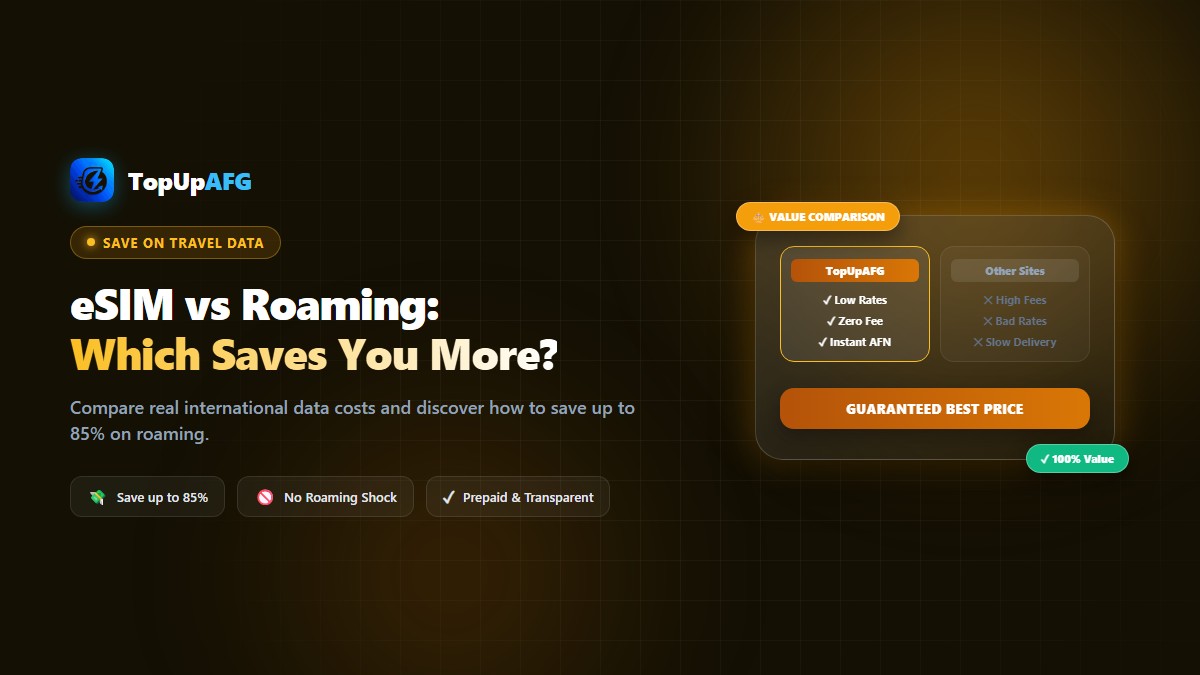
The cost for a travel eSIM is lower than the price for carrier roaming for the majority of individuals who move between countries. The user pays a specific amount of money for a defined volume of data rather than the daily or per megabyte fees of a domestic telecommunications provider. Roaming is simpler because the user does not perform any setup actions - but the higher ease of use results in a financial charge that is significantly larger - this document compares the two options based on the total expense, the rate of data transfer, the network range and the level of management. With this information, the user makes a selection while they understand the facts of the situation.
The following summary provides a comparison of costs - in the event that a traveler utilizes a mobile device for more than a small number of electronic communications, a digital SIM card is cheaper in most instances. There is a possibility that a roaming service is easier to use if a traveler remains in a different country for a short duration and does not operate the device.
What is the real difference?
The state of roaming occurs when a mobile subscriber connects a home SIM card to a telecommunications network in another country. Under this arrangement, the home carrier charges the mobile user for the services that the subscriber consumes while outside the domestic territory. By contrast a travel eSIM is a secondary digital data plan that a traveler purchases specifically for use at a destination for a fixed cost. There are higher financial rates for the mobile user when roaming because the home carrier acts as an intermediary for the foreign network. With a travel eSIM, the mobile user pays the same rates that a resident of that specific country pays for mobile data.
Which is cheaper, eSIM or roaming?
The following sentences describe how the two entities compare regarding the factors that change the amount of money a customer owes.
| Factor | Travel eSIM | Carrier roaming |
|---|---|---|
| Price | Fixed, paid up front | Per-day or per-MB, billed later |
| Cost level | Usually much lower | Often several times higher |
| Bill surprises | None - you pay before you travel | Common, especially for data |
| Setup | Scan a QR code once | Nothing to set up |
| Your number | Kept active on your home SIM | Kept active |
The mobile network provider charges a fee for roaming "day pass" during a seven day period in a foreign country - this expense is higher than the price of a digital SIM card data package which remains active for the full duration of the travel. As the number of days spent traveling increases, the difference between those two costs becomes larger.
Is roaming ever the better choice?
The activation of roaming is appropriate in multiple specific situations. If a traveler crosses a national border for a short duration, the lack of effort is efficient. There is also a benefit to this method if a telecommunications provider includes international data access within a service contract. It is an option when a customer chooses to not interact with any mobile applications. The technology is useful as a secondary connection during the initial period after an airplane lands - this connection functions until the user enables an electronic SIM card.
What about speed and coverage?
The functional electronic Subscriber Identity Module links to the identical primary domestic cellular infrastructures that a mobile device accesses during roaming. Real time data rates and signal availability are therefore equivalent between those technologies. In multiple situations, service providers decrease roaming speeds after a user exceeds a specified data threshold - but an electronic Subscriber Identity Module provides the maximum local transfer rate for the quantity of data that the user purchased. On every occasion, the user must verify that the digital service plan includes the particular nation or geographic area where the traveler moves.
How to get the best of both
The mobile phone users who travel often operate with a specific method. They maintain the original SIM card inside the device to receive voice calls & SMS messages - those individuals deactivate the data roaming function on that primary card. All internet connectivity is routed through a secondary travel eSIM. By this method the telephone number remains active for incoming contacts. The traveler avoids paying extra fees for internet usage abroad and pays a single set amount for the data package. It is the most affordable arrangement for the majority of journeys. To set up this configuration requires less than two minutes.
Frequently asked questions
Is a travel eSIM really cheaper than roaming?
The consumer benefits from a dedicated plan if the consumer uses data frequently. The consumer pays a set amount of money for the data. In this scenario the user avoids the roaming fees that mobile network operators charge - those fees are significantly more expensive than the fixed price. With this arrangement, the cost is lower for the mobile user.
Can I use an eSIM and still keep my phone number?
The home subscriber identity module is the technology that maintains the telephone number for voice communication and short messages. The embedded subscriber identity module is the component that transmits cellular data. You are able to deactivate the data roaming function on the primary telephone service.
Does roaming give better coverage than an eSIM?
The situation is not common - A functional eSIM connects to the identical primary telecommunication infrastructures in the area. The signal reach and data transfer rates are equal to traditional methods. It is possible that the connection is more rapid. The reason for this is that cellular providers often limit the bandwidth for customers who travel across borders.
What is the cheapest way to get data abroad?
The traveler purchases a digital SIM card for a specific location prior to departure. She installs the electronic chip into the mobile device. She deactivates the data roaming function for the original network provider. The cellular phone transmits all internet traffic through the pre paid digital card. Because of this configuration, the costs for data usage remain at a set rate.
Skip the roaming bill
If you want to avoid an unpredictable charge for roaming, a travel eSIM provides a specific cost, data rates that match local networks and an active personal telephone number. The website allows you to evaluate travel eSIM options for more than 150 nations. It is beneficial to select a service before your following journey begins.